

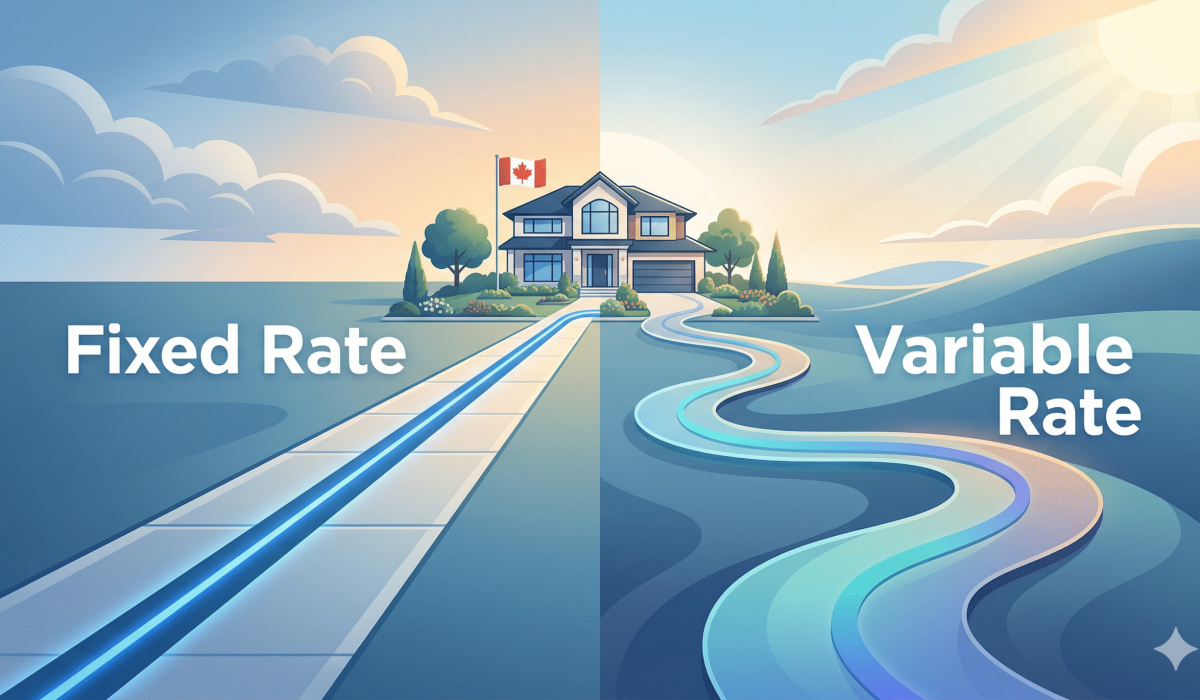
Fixed vs. Variable: The 2026 Ontario Market Outlook
Last Updated: April 2026
The age-old mortgage question has never been more relevant. With the Bank of Canada prime rate currently sitting at 4.45% and the central bank’s “neutral rate” hovering around 2.25%, Ontario borrowers are facing a pivotal decision: lock in the certainty of a fixed rate, or bet on falling rates with a variable mortgage?
This isn’t a simple question—and anyone who gives you a one-size-fits-all answer isn’t being honest. Your decision depends on market conditions, yes, but also on your personal risk tolerance, financial flexibility, and how long you plan to stay in your home.
Let’s break down the 2026 Ontario mortgage market trends and give you a framework to decide.
Understanding the Current Rate Environment
Before comparing fixed and variable mortgages, you need to understand what’s driving today’s rates.
Key Numbers You Should Know (April 2026):
| Rate Type | Current Level | What It Means |
|---|---|---|
| Bank of Canada Policy Rate | 4.20% | The overnight rate banks use as their baseline |
| Prime Rate | 4.45% | What variable mortgage rates are based on (Prime +/- adjustment) |
| BoC “Neutral Rate” Estimate | 2.25% | Where the BoC believes rates should settle long-term |
| 5-Year Bond Yield | ~3.40% | What 5-year fixed mortgage rates are based on |
The gap between today’s Bank of Canada prime rate and the neutral rate tells an important story: there’s potentially 2% of rate cuts still on the table. Whether and when those cuts happen is the trillion-dollar question.
Fixed Rate Mortgages: Certainty Has a Price
A fixed-rate mortgage locks your interest rate for the entire term—typically 5 years in Canada. Your payments stay exactly the same regardless of what the Bank of Canada does.
Current 5-Year Fixed Rates in Ontario:
- Insured (less than 20% down): 4.29% – 4.59%
- Insurable (20%+ down, under $1M): 4.39% – 4.69%
- Uninsurable (refinance, rental, over $1M): 4.59% – 4.99%
Pros of Fixed Rates:
- Payment certainty: Budget with confidence for 60 months
- Protection from rate increases: If you’re wrong about rates falling, you’re protected
- Peace of mind: No stress watching BoC announcements
- Lower current rates: Fixed rates are currently lower than variable in many cases
Cons of Fixed Rates:
- Higher penalties for breaking: Interest Rate Differential (IRD) penalties can be brutal—often $15,000 to $30,000+ on a typical GTA mortgage
- Opportunity cost: If rates drop 1.5%, you’re stuck at today’s rate
- Less flexibility: Porting or blending options may be limited
Variable Rate Mortgages: Riding the Rate Roller Coaster
Variable mortgages are tied to the Bank of Canada prime rate. When the BoC cuts rates, your interest rate drops. When they hike, your rate rises. In Ontario’s competitive mortgage market, variable rates are typically offered as “Prime minus X%”.
Current Variable Rates in Ontario:
- Best discounted variable: Prime – 0.75% to Prime – 0.95% (effective rate: 3.50% – 3.70%)
- Standard variable: Prime – 0.25% to Prime – 0.50% (effective rate: 3.95% – 4.20%)
Note: Some lenders offer “fixed payment” variable mortgages where your payment stays the same but the interest/principal split adjusts. Others offer “adjustable payment” variables where your payment changes with each rate move.
Pros of Variable Rates:
- Lower starting rate: Currently, well-discounted variables are significantly below fixed rates
- Rate cut upside: If the BoC continues cutting, your effective rate could drop to 3.0% or lower
- Lower break penalties: Variable mortgages typically have only 3-month interest penalties—often $3,000 to $6,000 versus $20,000+ for fixed
- Flexibility: Easier to refinance, port, or break if your situation changes
Cons of Variable Rates:
- Rate risk: If inflation resurges, the BoC could pause cuts—or even hike
- Payment uncertainty: Harder to budget long-term (especially with adjustable payment variables)
- Stress factor: Every BoC announcement becomes personally relevant
- Potential for “trigger rate”: If rates rise enough, your payment may no longer cover interest costs
The 2026 Ontario Mortgage Market: Why Competition Matters
Ontario isn’t like other provinces. The Ontario mortgage market trends are shaped by sheer volume—this province represents roughly 40% of all Canadian mortgage originations. That competition drives rates lower.
Why Ontario Borrowers Often Get Better Rates:
- Lender competition: More lenders competing for Ontario business means tighter spreads
- Higher property values: Bigger mortgages mean lenders can afford thinner margins
- Broker market share: Ontario has high broker penetration, which drives competition
- Urban density: GTA/Ottawa volumes allow for efficiency that reduces lender costs
What this means for you: the “best rate” you see advertised nationally is often actually available in Ontario, while borrowers in smaller markets may struggle to access it.
Your Personal Decision Framework
Choosing between fixed and variable isn’t about predicting rate movements—it’s about understanding your own situation. Use this mortgage renewal strategy checklist:
Choose FIXED If:
- ☐ Your budget has zero flexibility for payment increases
- ☐ You’re at your maximum qualification limit
- ☐ Rate announcements cause you genuine anxiety
- ☐ You’re unlikely to move or refinance in the next 5 years
- ☐ You believe rates will stay elevated or rise
- ☐ You value certainty over potential savings
Choose VARIABLE If:
- ☐ You can comfortably absorb a 1-2% rate increase
- ☐ You may sell, refinance, or relocate within 3-4 years
- ☐ You believe the BoC will continue cutting toward neutral
- ☐ You’re comfortable with some payment fluctuation
- ☐ You want lower break penalties as insurance
- ☐ You’re willing to monitor rates and potentially convert to fixed later
Consider a HYBRID Approach If:
- ☐ You’re genuinely uncertain about rate direction
- ☐ You want to hedge your bets
- ☐ Some lenders offer split mortgages (50% fixed, 50% variable)
The Math: A Side-by-Side Comparison
Let’s model a $650,000 mortgage (typical for a GTA purchase) over the first 3 years:
Scenario 1: Rates Fall as Expected
Assumption: BoC cuts another 1.25% over 18 months
| Metric | 5-Year Fixed (4.49%) | Variable (Prime – 0.85%) |
|---|---|---|
| Starting Rate | 4.49% | 3.60% |
| Rate After 18 Months | 4.49% | 2.35% |
| 3-Year Interest Cost | ~$81,500 | ~$58,200 |
| Variable Savings | ~$23,300 | |
Scenario 2: Rates Hold Steady
Assumption: BoC pauses, prime rate stays at 4.45%
| Metric | 5-Year Fixed (4.49%) | Variable (Prime – 0.85%) |
|---|---|---|
| Effective Rate | 4.49% | 3.60% |
| 3-Year Interest Cost | ~$81,500 | ~$65,300 |
| Variable Savings | ~$16,200 | |
Scenario 3: Rates Rise Unexpectedly
Assumption: Inflation spikes, BoC adds 0.75%
| Metric | 5-Year Fixed (4.49%) | Variable (Prime – 0.85%) |
|---|---|---|
| Rate After Hike | 4.49% | 4.35% |
| 3-Year Interest Cost | ~$81,500 | ~$78,900 |
| Fixed “Savings” | ~$2,600 | |
Key insight: Even in the “worst case” scenario for variable, the difference is minimal. In the “best case,” variable saves over $23,000. This asymmetry is why many analysts currently favor variable—but your personal risk tolerance matters more than spreadsheet math.
Mortgage Renewal Strategy: What If You’re Already in a Mortgage?
If your mortgage is coming up for renewal, the fixed vs. variable decision gets more nuanced.
Renewal Considerations:
- Don’t just sign the renewal letter: Banks offer non-competitive rates to existing customers. Always shop around or work with a broker.
- Factor in your remaining amortization: If you have 20 years left, rate savings compound more significantly
- Consider your current rate: If you’re coming off a 1.89% pandemic rate, anything feels painful—but that’s sunk cost thinking
- Evaluate your equity position: Higher equity may qualify you for better rates
The Renewal Shopping Timeline:
- 120 days before maturity: Start shopping rates
- 90 days before: Get pre-approvals to lock in rates
- 60 days before: Compare offers and negotiate
- 30 days before: Finalize your decision
- At maturity: Seamless transition to new rate/term
The Expert Consensus (And Why You Should Be Skeptical)
Most mortgage professionals currently lean toward variable rates, citing:
- The gap between current rates and the neutral rate
- BoC’s stated intention to normalize policy
- Lower break penalties providing flexibility
- Historical data showing variable wins more often than not
But remember: these same experts didn’t predict the 2022-2023 rate spike. Economic forecasting is notoriously difficult. The “smart” choice on paper may not be the right choice for your life.
The Bottom Line: Know Yourself
The fixed vs variable mortgage 2026 decision isn’t about being right about rates. It’s about choosing the option that lets you sleep at night while optimizing for your specific situation.
In Ontario’s competitive market, both options are priced aggressively. You’re not making a “bad” choice either way. The real mistake is signing your bank’s renewal letter without shopping around, or choosing based on what worked for your parents’ generation.
Use the framework above. Run the scenarios. Talk to a professional who can model your specific numbers. Then make a decision you can live with for the next 5 years.
Need Help Deciding Between Fixed and Variable?
At mrates.ca, we don’t push one-size-fits-all advice. Our mortgage professionals will analyze your specific situation—income stability, risk tolerance, property plans, and financial goals—to recommend the right structure for you. We have access to 50+ lenders, ensuring you get competitive rates regardless of which path you choose.
→ Book Your Free Fixed vs. Variable Consultation
Have questions about the 2026 rate outlook or your mortgage renewal strategy? Drop them in the comments or reach out directly.
Related Reading: