If you are buying a home, refinancing, or planning a mortgage switch in 2026, the mortgage stress test 2026 rules directly control how much you can borrow. It is not optional, it is not easy to bypass, and it is currently undergoing its most significant potential change in nearly a decade.
Here is what the mortgage stress test 2026 requires today, what OSFI is proposing to replace it, and how to position yourself before the rules shift.
Minimum stress test floor rate for all qualifying calculations
Added to your contract rate — whichever is higher is your qualifying rate
Proposed LTI income cap under new OSFI framework for uninsured mortgages
How the Mortgage Stress Test 2026 Works
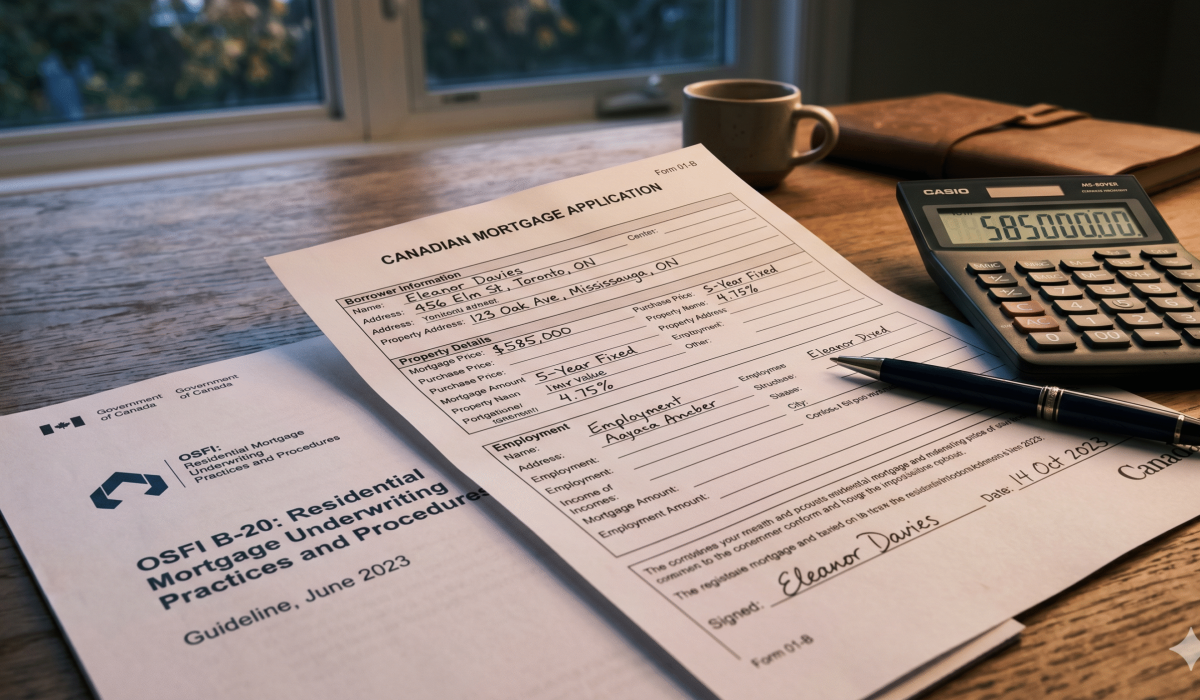
The mortgage stress test 2026, formally OSFI’s Guideline B-20, requires federally regulated lenders to qualify all mortgage applicants at a rate significantly higher than the rate they will actually pay. The idea is to ensure borrowers can handle payments if rates rise during their term.
The 2026 Qualifying Rate Formula
Qualifying Rate = Higher of: Contract Rate + 2% OR 5.25%
At today’s lowest insured 5-yr fixed rate of 4.04%, your qualifying rate is 6.04% — since 4.04% + 2% = 6.04%, which is higher than the 5.25% floor.
In practice, this means every mortgage application is stress-tested at approximately 2 percentage points above the rate you negotiated. For a borrower earning $100,000 per year, this reduces maximum qualification by roughly $70,000–$100,000 compared to qualifying at the actual contract rate.
Who Must Pass the Stress Test
The Big Change: How OSFI Could Reshape the Mortgage Stress Test 2026
In 2024, OSFI signalled a potential shift away from the stress test’s rate-based formula toward a Loan-to-Income (LTI) approach. Under this proposed framework, lenders would cap new uninsured mortgages at 4.5 times a borrower’s gross annual income, rather than qualifying borrowers against an artificially elevated rate. Full details on the current B-20 guideline are published on OSFI’s mortgage underwriting guideline page.
As of April 2026, the LTI framework is still under evaluation and has not replaced the mortgage stress test 2026 rules. OSFI’s most recent update indicated the review will continue into 2026, with no confirmed implementation date. The current stress test (contract rate + 2%) remains the operative rule.
Stress Test vs. LTI: What Changes for Buyers?
$560K
Max mortgage at $100K income, qualifying at 6.04% (4.04% + 2%), 25-yr amortization, no other debts.
$450K
Max mortgage at $100K income under a 4.5× gross income cap. LTI actually reduces borrowing power in the current rate environment.
Counterintuitively, the LTI framework may reduce borrowing power for many buyers right now. When contract rates sit around 4%–4.3%, the stress test qualifying rate (6%+) is the harder hurdle. As rates fall, the LTI income cap could become the tighter constraint — particularly in expensive markets like the GTA and Greater Vancouver.
In the Greater Toronto Area, where the average home price exceeds $1M, a 4.5× LTI cap would limit a dual-income household earning $180,000 combined to a maximum mortgage of $810,000 — well below typical detached home prices.
Who Benefits and Who Loses Under LTI
What to Do Before the Mortgage Stress Test 2026 Rules Change
1. Get Pre-Approved and Lock In a Rate Hold
Most lenders offer rate holds of 90–120 days. Getting pre-approved now secures your qualifying amount under the current stress test formula. If the LTI framework is introduced and proves less favourable for your income profile, you’ll be protected under the rules in place at the time of your pre-approval.
2. Calculate Your LTI Ratio
Divide your target mortgage amount by your gross annual household income. If the result exceeds 4.5, you would not qualify under the proposed LTI cap — factor that into your home price target now, before you commit to a purchase.
3. Evaluate Credit Union Options
Provincial credit unions in Ontario are not subject to OSFI’s B-20 stress test and may continue operating under their own internal guidelines even after an LTI implementation. For buyers who struggle under the federal stress test, a credit union consultation is worth exploring today.
Straight renewals with the same lender at the same balance are exempt from the mortgage stress test 2026 rules. However, if you switch to a new lender at renewal — even to get a better rate — the stress test applies. Brokers can often find rates 20–50 basis points lower than your current lender’s offer, making this trade-off worth calculating carefully.
Other 2026 Mortgage Rule Changes You Should Know
Know Your Numbers Before the Rules Change
Our team at mrates.ca can run your numbers under both the current mortgage stress test 2026 rules and the proposed LTI model — so you can plan your purchase or renewal strategically. You can also run your own numbers on our mortgage payment calculator.
Frequently Asked Questions
Does the mortgage stress test 2026 apply when I renew?
Not if you renew with your current lender without changing the balance or amortization. However, if you switch to a new lender at renewal — even to access a better rate — the stress test applies at that new lender. Insured mortgage holders switching lenders at renewal have been exempt since November 2024; uninsured holders switching lenders still face the test.
What is the qualifying rate on a variable mortgage?
The same formula applies: the higher of your variable rate + 2%, or 5.25%. At today’s best variable rate of 3.35%, the qualifying rate is 5.35% — only marginally above the 5.25% floor. This makes fixed and variable qualification amounts very similar in the current environment.
When will the OSFI LTI change to the mortgage stress test 2026 take effect?
As of April 2026, no implementation date has been confirmed. OSFI has stated the evaluation will continue, and the existing stress test remains in force. Any rule change would apply to new applications, not existing mortgage holders.
Can I avoid the stress test by going to a private lender?
Private lenders and B-lenders are not subject to OSFI’s B-20 stress test. However, they charge significantly higher rates (often 6–12%+) and require larger down payments. This may be viable as a short-term bridge but is not a cost-effective long-term solution for most buyers.
This article is for informational purposes only and does not constitute mortgage, financial, or legal advice. Mortgage rules and qualification requirements are subject to change. Information is accurate as of publication date. Please consult a licensed mortgage professional before making any borrowing decisions.