

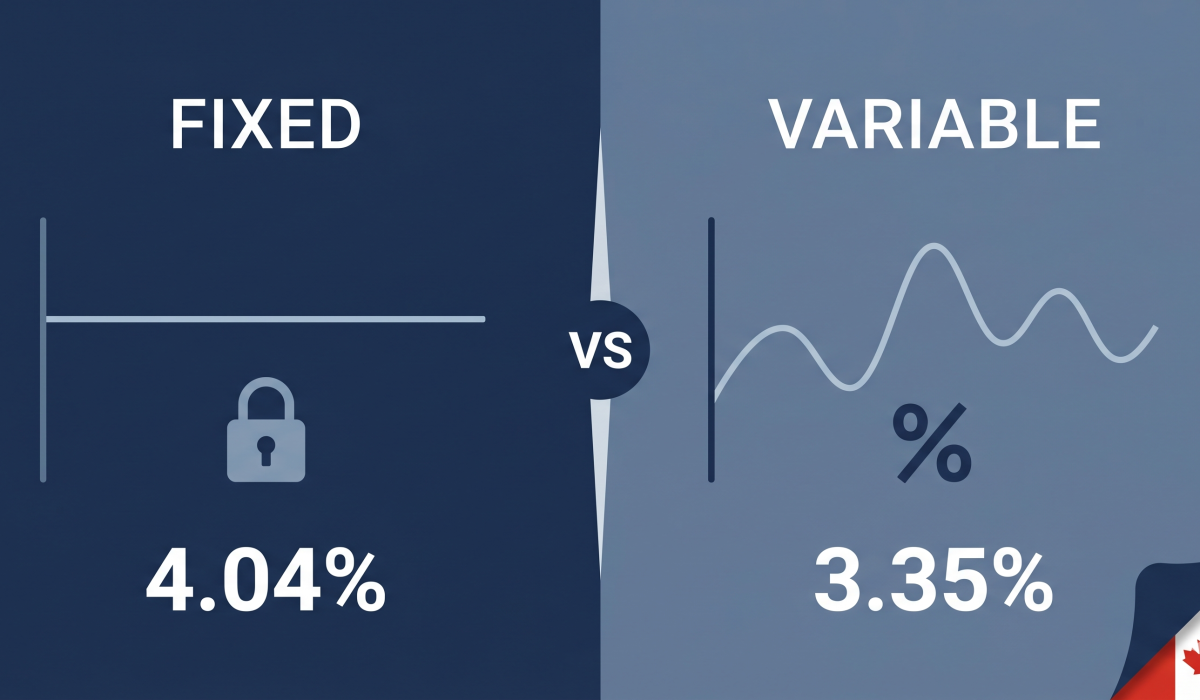
Fixed or variable — it’s the question every Canadian mortgage holder faces at renewal or purchase, and in 2026 it’s more complicated than it’s been in years. Variable rates are nearly a full percentage point below fixed, which looks attractive. But fixed offers protection against a rate environment where geopolitical shocks and trade tensions have put hikes back on the table. Here’s how to actually decide.
The Numbers Today
Understanding the decision starts with knowing the actual gap. As of late April 2026, the spread between fixed and variable at the broker level sits at approximately 0.65%–0.75%:
| Option | Best Broker Rate | Key Risk |
|---|---|---|
| 5-Year Fixed | ~4.04% | Overpay if rates drop; penalty to break early |
| 5-Year Variable | ~3.35% | Payment rises with every BoC hike |
| 3-Year Fixed | ~4.69% | Currently inverted — higher than 5-year fixed |
| 1-Year Fixed | ~5.20%+ | Bet on significant rate drops by 2027 — risky |
The yield curve is currently inverted on shorter terms — meaning 1-year and 3-year fixed rates are higher than 5-year fixed. This is the bond market pricing in greater near-term uncertainty than long-term uncertainty. It’s an unusual environment, and it matters to how you think about term selection.
The Case for Fixed in 2026
Fixed mortgages make the most sense when rate risk is skewed to the upside — and in 2026, that risk is real for the first time since 2022:
- Geopolitical oil shock: The conflict in Iran has pushed crude oil near US$100/barrel, driving headline inflation back toward 3% in Canada. If energy prices stay elevated, the Bank of Canada may be forced to hike even in a weak economy — what economists call a stagflationary scenario.
- Bank forecasts on hikes: Scotiabank has explicitly flagged the possibility of three BoC rate hikes in the second half of 2026. National Bank and TD have both noted markets have priced in at least one increase. These are not fringe views.
- Each 25 bps hike costs you real money: On a $500,000 variable mortgage, a single 0.25% rate increase adds roughly $100–$110/month. Three hikes would cost you $300+/month extra — erasing most of your variable advantage quickly.
- Peace of mind has real value: A fixed mortgage means your budget is set for five years regardless of what happens to oil prices, tariffs, or geopolitics. For households with tight cash flow, that certainty can be worth the premium.
The Case for Variable in 2026
Variable still wins if you believe the BoC holds — and the base case across most forecasters still supports that view:
- BoC held at 2.25% in March and is expected to hold again April 29: Bond markets price only a 5% probability of a cut, but an even smaller probability of a hike at this meeting. The BoC is explicitly in “wait and see” mode.
- Weak economy suppresses hike urgency: With GDP barely positive in January 2026 and unemployment at 6.7%, the BoC has significant reason to avoid tightening even if inflation ticks up. The Bank has signalled it views the current oil spike as transitory.
- RBC and TD base case: no hikes in 2026: Both institutions expect the policy rate to remain at 2.25% through the end of the year. If they’re right, variable holders will have saved roughly 0.70% annually versus fixed — over $3,000 on a $500K mortgage across a single year.
- Variable is better if you may break early: The penalty to break a variable mortgage is typically 3 months’ interest. Fixed-rate penalties can reach 4–6 months’ interest or more (especially IRD penalties at big banks). If there’s any chance you’ll sell or refinance before 5 years, variable has a structural advantage.
The Break-Even Analysis
Here’s a practical way to frame the decision. Starting at variable (3.35%) vs. fixed (4.04%), the variable borrower is saving 0.69% per year. For the fixed rate to “win,” rates would need to rise enough to overcome that starting advantage. On a $500,000 mortgage:
| Scenario | Variable Total Interest (5 yrs) | Fixed Total Interest (5 yrs) | Winner |
|---|---|---|---|
| BoC holds at 2.25% all 5 years | ~$77,500 | ~$93,200 | Variable by ~$15,700 |
| BoC hikes 3× by +0.75% in 2026 | ~$89,100 | ~$93,200 | Variable still wins (~$4,100) |
| BoC hikes 5× by +1.25% total | ~$96,500 | ~$93,200 | Fixed wins (~$3,300) |
Estimates for illustration only. Actual amounts depend on amortization, payment structure, and timing of rate changes.
How to Choose: A Simple Decision Framework
- Choose fixed if: Your budget is tight, you can’t absorb payment increases of $200–$400/month, you plan to stay in the home for the full 5 years, or you’d lose sleep watching rate announcements.
- Choose variable if: You have cash flow flexibility, you believe the BoC holds or hikes only modestly, you may sell or refinance within 3–4 years, or you understand and accept the payment variability risk.
- Consider a shorter fixed term (2-year) if: You believe rates will be materially lower by 2028 and want to relock at a lower rate then. Note: the 3-year fixed at 4.69% is currently unattractive versus the 5-year at 4.04% — the inverted curve makes 3-year fixed a poor value.
Bottom Line
In most rate environments, variable has outperformed fixed over full 5-year terms historically. 2026 is different only in that the downside risk for variable is back on the table in a way it wasn’t in 2024–2025. The spread is meaningful. The risk is real but not inevitable. Neither choice is wrong — the right answer depends on your financial cushion and your personal tolerance for uncertainty.
Compare today’s fixed and variable rates side by side at mrates.ca — updated daily.