

Bank of Canada Rate September 2026: 7 Key Facts for Your Mortgage
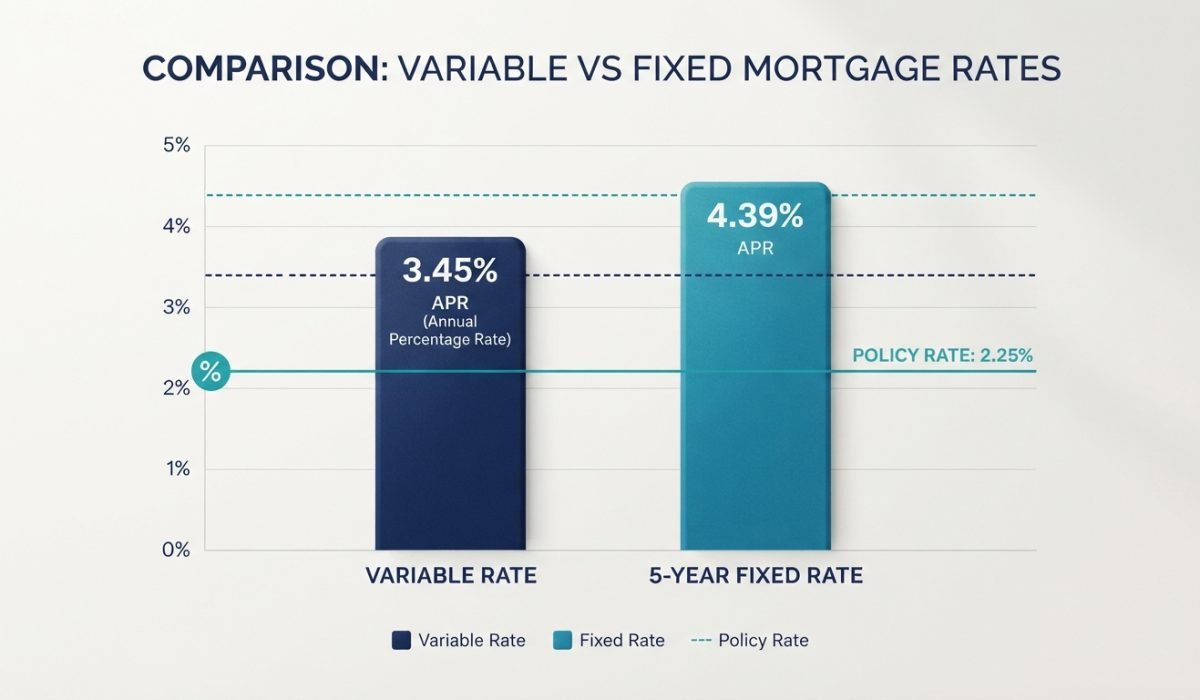
The Bank of Canada rate September 2026 decision came on September 2: the Bank held its policy rate at 2.25%. That makes seven straight holds since October 2025. If you have a variable mortgage, a renewal coming up, or a pre-approval in hand, here is what the hold changes for you and what it does not.
[rank_math_toc]
Bank of Canada rate September 2026: the numbers at a glance
The Bank kept the overnight target at 2.25%, the Bank Rate at 2.5% and the deposit rate at 2.20%. The next announcement is October 28, 2026, and it comes with a full Monetary Policy Report. The last decision of the year is December 9.
| Measure | Level after Sept 2 decision |
|---|---|
| Policy (overnight) rate | 2.25% |
| Big-bank prime rate | 4.45% |
| CPI inflation (July) | About 3% |
| Inflation excluding gasoline (July) | 2.2% |
| Q2 GDP growth (annualized) | 3.3% |
| Unemployment rate (July) | 6.4% |
You can read the full statement in the Bank of Canada press release.

Why the Bank of Canada rate September 2026 decision was a hold
Headline inflation sat near 3% in July. Most of that came from gasoline, as conflict in the Middle East kept oil prices high. Core measures stayed close to 2%, which is the Bank’s target.
The economy also bounced back. GDP grew 3.3% in the second quarter after a weak first quarter, with gains in consumer spending, housing, exports and business investment. Unemployment improved to 6.4%.
A cut would have added fuel to an economy that is already picking up while inflation runs above target. The Bank also flagged new U.S. tariffs as a source of uncertainty and said it is prepared to adjust policy as needed.
What the hold means for variable-rate mortgages
For variable borrowers, the Bank of Canada rate September 2026 hold is simple. Your variable rate is tied to prime, and prime follows the policy rate. With no change on September 2, prime stays at 4.45% and your rate stays where it is.
If you have an adjustable-rate mortgage, your payment does not move. If you have a variable mortgage with fixed payments, the split between interest and principal does not change either.
Discounted variable offers were around prime minus 1.00% in early September, or about 3.45%, according to nesto’s rate tracker.
Why fixed rates went up anyway
This part confuses many borrowers. Fixed mortgage rates follow Government of Canada bond yields, not the overnight rate. The 5-year bond yield climbed through August to roughly 3.35%, close to a 52-week high.
Lenders priced that in. The best 5-year fixed rates moved to about 4.39%, while 3-year fixed sat near 4.44%. So a Bank of Canada hold can still come with higher fixed rates if bond markets expect inflation to stay sticky.
How the September 2026 hold affects the stress test
The mortgage stress test did not change. You still qualify at the higher of 5.25% or your contract rate plus 2 percentage points.
At a 4.39% fixed rate, you qualify at 6.39%. On a $500,000 mortgage over 25 years, the real payment is about $2,737 a month, but the lender checks whether you can carry about $3,316. That gap is why rising bond yields shrink buying power even when the Bank does nothing.
Run your own numbers with our mortgage affordability calculator before you make an offer.

Fixed or variable after the Bank of Canada rate decision?
There is no single right answer, but the spread matters. Right now, a discounted variable is close to a full point below the best 5-year fixed.
Reasons to lean variable
- You start about 0.9 points lower, which cuts early interest costs.
- Most variable mortgages let you lock in later without a penalty.
- Prepayment penalties are usually capped at three months’ interest.
Reasons to lean fixed
- The Bank warned of upside inflation risk, so the next move is not guaranteed to be a cut.
- Your payment is known for the full term, which helps a tight budget.
- If bond yields fall later, you may be able to refinance, though penalties apply.
If you would lose sleep over a rate increase, the lower variable rate may not be worth it. Compare both on our Ontario mortgage rates page.
What to watch before October 28
- The August CPI release in mid-September, especially gasoline and core inflation.
- The 5-year Government of Canada bond yield, which moves fixed rates.
- Labour Force Survey data for August and September.
- Any update on U.S. tariffs and Canada’s response.
If core inflation stays near 2% and job growth cools, the October meeting could open the door to a cut later in the year. If gasoline keeps pushing headline inflation up, another hold is more likely.
What Ontario borrowers can do now
- Renewing in the next 120 days? Ask your lender for a rate hold now. Most lenders will hold a rate for 90 to 120 days, and you can still take a lower rate if one appears.
- Buying this fall? Get a pre-approval with a rate hold so a rise in bond yields does not cut your budget before you find a home.
- On a variable rate? Check your lock-in options, but do not rush. Your rate did not change on September 2.
- Carrying other debt? Your gross and total debt service ratios affect approval as much as the rate does.
Payments at today’s rates
Here is what the Bank of Canada rate September 2026 environment looks like in monthly payments on a 25-year amortization. The last column is the rate the stress test uses for a 4.39% fixed mortgage.
| Mortgage | Variable 3.45% | Fixed 4.39% | Qualifying 6.39% |
|---|---|---|---|
| $300,000 | $1,490 | $1,642 | $1,990 |
| $500,000 | $2,483 | $2,737 | $3,316 |
| $700,000 | $3,476 | $3,832 | $4,642 |
Payments are rounded and use semi-annual compounding. They do not include property tax, CMHC premiums or condo fees.
How we got to 2.25%
The Bank cut its policy rate several times through 2024 and 2025 as inflation came back toward target. The last cut, to 2.25%, came in October 2025. Since then the Bank has held at every meeting while it watches oil prices, tariffs and a stronger second-quarter economy.
A long hold is not unusual. It gives the Bank time to see whether core inflation stays near 2% before it moves again in either direction.
What it means for first-time buyers
First-time buyers can take a 30-year amortization on an insured mortgage, and the insured mortgage cap is $1.5 million. Both rules have been in place since December 2024. A longer amortization lowers the payment and helps you pass the stress test, though you pay more interest over time.
With the Bank of Canada rate September 2026 hold and fixed rates edging up, a pre-approval with a rate hold is the best way to protect your budget while you shop. Our first-time buyer guide covers the incentives available in Ontario.
Frequently asked questions
Should I lock in my variable rate now?
Not because of this decision alone. Prime did not change. Compare the fixed rate you would get today with your current variable rate and your comfort with future moves.
Will the Bank of Canada cut rates in October 2026?
Nobody knows yet. The Bank said it is ready to adjust policy in either direction, and it will publish a new forecast with the October 28 decision.
What is the Bank of Canada rate in September 2026?
The policy rate is 2.25% after the September 2, 2026 announcement. The Bank has held at this level since October 2025.
When is the next Bank of Canada rate announcement?
October 28, 2026, followed by December 9, 2026.
Did mortgage rates change after the September 2026 decision?
Variable rates stayed the same because prime did not move. Fixed rates rose in August and early September because bond yields went up.
Does the Bank of Canada set fixed mortgage rates?
No. Lenders price fixed mortgages off Government of Canada bond yields, plus their own margin.
Compare today’s rates with mrates.ca
The Bank of Canada rate September 2026 hold keeps variable payments steady, while fixed rates follow the bond market. Compare offers from Ontario lenders side by side on mrates.ca and lock in a rate hold before your renewal or purchase date.