
If you have a mortgage renewing in 2026, or you’re planning to buy a home this year, there is one question everyone is asking: are Canadian mortgage rates going up or down in 2026? The honest answer is — it depends on forces most Canadians aren’t watching closely enough. This in-depth guide breaks down exactly what’s happening right now, what the Big 6 banks are forecasting, how global events are shifting the picture, and what you should actually do with your mortgage today.
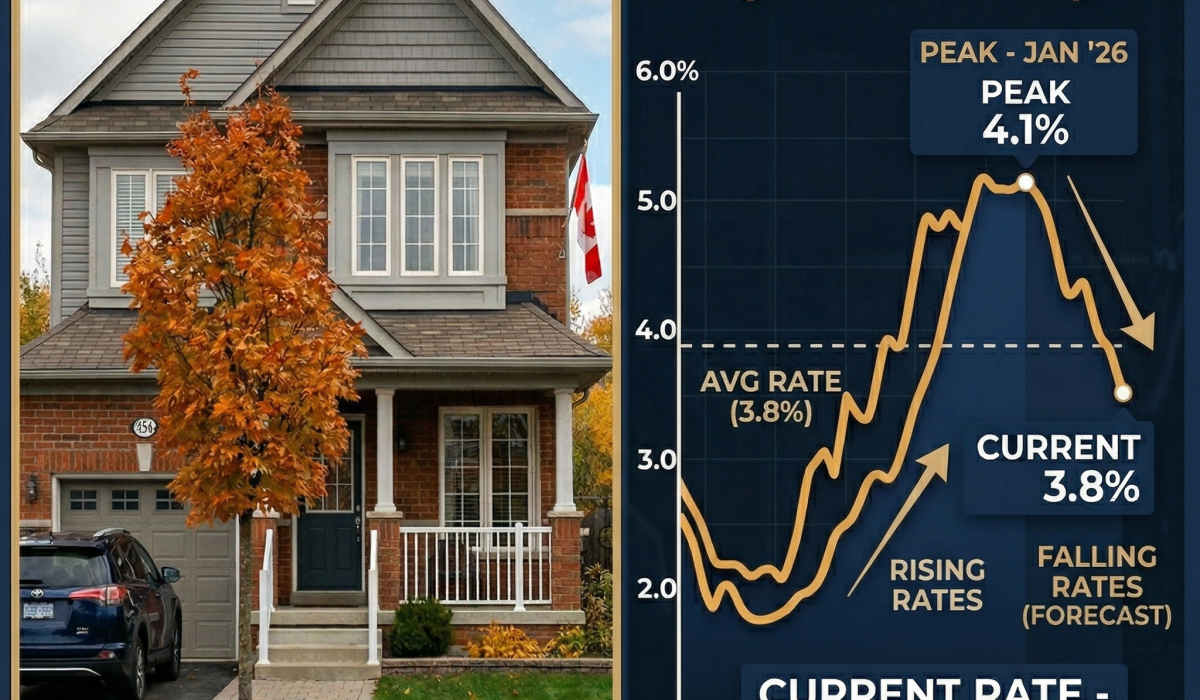
On March 18, 2026, the Bank of Canada held its overnight rate at 2.25% — the bottom of its neutral range. The prime rate remains at 4.45%. Best 5-year fixed rates are currently 3.89%–4.49%. Best 5-year variable rates are around 3.45%. This page reflects the most current data available.
Where Canadian Mortgage Rates Stand Right Now
After four rate cuts totalling 100 basis points through 2025, the Bank of Canada brought its overnight rate down from 3.25% to 2.25% — the lowest level in the so-called “neutral range.” Here’s the current snapshot:
Sources: Bank of Canada, nesto.ca, rates.ca, Perch, True North Mortgage — March 2026
What the Big 6 Banks Are Forecasting for 2026
Canada’s major banks don’t all agree — and that disagreement itself tells you something important about how uncertain this rate environment really is:
Bottom line: Most major banks expect rates to hold at 2.25% through 2026. The minority view — Scotiabank and National Bank — see a potential hike of 25–50 basis points, most likely in Q4 2026 or early 2027. Neither a dramatic cut nor a large hike is the base case.
Variable-rate mortgage holders: your payments are unlikely to change significantly in the near term. Fixed-rate shoppers: the best rates today (3.89%+) are competitive — and could drift slightly higher if bond yields rise further due to global uncertainty.
3 Big Forces That Could Push Rates Up in 2026
1. The Iran Conflict and Oil Price Shock
This is the wildcard nobody predicted. U.S. and Israeli strikes on Iran beginning February 28, 2026 triggered a partial blockade of the Strait of Hormuz — through which roughly one-fifth of the world’s oil passes. Brent crude briefly topped US$100/barrel before settling near US$90. Higher oil prices feed directly into Canadian inflation, which gives the Bank of Canada reason to pause or even consider a rate hike. Bond yields have already risen approximately 30 basis points as a result, pushing fixed mortgage rates higher in March 2026.
If oil prices remain elevated through mid-2026, the Bank of Canada may be forced to hike rates to combat renewed inflation — even in a weakening economy. This is the scenario Scotiabank and Desjardins are pricing in.
2. US–Canada Trade Tensions (Tariffs)
Ongoing US-Canada trade negotiations and tariff uncertainty continue to weigh on business investment and consumer confidence. The mandatory CUSMA/USMCA six-year review in 2026 adds further unpredictability. Trade disruptions could push up consumer prices — a form of cost-push inflation that may compel the Bank of Canada to act on rates sooner than expected.
3. Government Debt and Bond Supply
As the federal government issues more bonds to fund spending, investors demand higher returns — putting upward pressure on bond yields, and therefore fixed mortgage rates, independent of what the Bank of Canada does. This is a longer-term structural pressure that most Canadians overlook entirely.
3 Big Forces That Could Push Rates Down in 2026
1. Canada’s Slowing Economy
Canada’s GDP contracted 0.6% in Q4 2025, and the economy shed 84,000 jobs in February 2026 alone. The Bank of Canada projects GDP growth of only 1.1% for 2026 — the weakest in nearly a decade outside of COVID. A sharper-than-expected economic slowdown or recession would force the Bank to cut rates to stimulate the economy, pulling variable and eventually fixed rates lower.
2. Cooling Inflation
Canadian headline inflation fell to 1.8% year-over-year in February 2026, below the Bank of Canada’s 2% target. While core inflation remains slightly elevated at 2.5%–2.8%, the trend is downward. Continued cooling of inflation reduces pressure on the Bank to hold or raise rates, and increases room for potential cuts if the economy weakens further.
3. Resolution of Global Conflicts
If the Iran conflict de-escalates and oil prices fall back below US$75/barrel, the inflation pressure disappears — and the Bank of Canada would likely hold or potentially cut rates if the economy shows further weakness. Bond yields would fall in response, bringing fixed mortgage rates down with them.
The Mortgage Renewal Crisis Hitting Canada Right Now
Here is the number that should alarm every Canadian homeowner: approximately 1.2 million Canadian mortgages come up for renewal in 2026 — many of them locked in during 2020–2021 at rates below 2%. The payment shock for these borrowers is significant:
This is not a theoretical scenario — it’s happening to over a million Canadian families right now. The good news? 28% of Canadian homeowners are switching lenders at renewal, up 46% from the previous year, because they’ve discovered their bank’s renewal offer is almost never the best rate available.
Start the renewal process 120 days before your mortgage matures. Most lenders offer a free rate hold for 120 days — giving you insurance against rate increases while you shop. Your bank’s renewal letter is almost never their best offer. A mortgage broker will compare it against the full market for you.
Fixed vs. Variable in 2026: Which Is Right for You?
For the first time in three years, variable-rate mortgages have fallen below fixed-rate mortgages in Canada. This changes the calculus significantly for borrowers. Here’s how to think about it:
Choose Fixed If:
- You want complete certainty on your monthly payment for 3–5 years
- You’re renewing a large mortgage and can’t absorb payment increases
- You believe the Iran conflict will keep oil prices elevated, pushing rates higher
- You plan to stay in your home for the full term (minimize break penalty risk)
- Consider a 2- or 3-year fixed to avoid locking in current rates for too long
Choose Variable If:
- You can absorb a potential 0.50%–0.75% rate increase without financial stress
- You believe the Iran conflict will be short-lived and oil prices will fall
- You may need to break your mortgage early (penalty is typically just 3 months interest vs. the complex IRD calculation for fixed)
- You want to benefit if the Bank of Canada cuts rates again due to economic weakness
Most brokers are recommending a 2-year fixed or variable rate for borrowers who believe the current rate environment is near a floor. A shorter fixed term lets you benefit from potentially lower rates at renewal in 2027–2028 without taking on full variable risk today.
What Mortgage Rates Mean for the Canadian Housing Market in 2026
Rate movements don’t just affect your monthly payment — they reshape the entire housing market. Here’s the ripple effect playing out right now:
Inventory Is Building — Buyers Have More Power
US tariff threats and market uncertainty pushed many would-be buyers into “decision paralysis” through late 2025 and early 2026. The result: inventory has been building in Canada’s biggest real estate markets — Toronto, Vancouver, Calgary — tilting conditions firmly in favour of buyers for the first time in years. More choice, less competition, and more room to negotiate.
Rate Holds Are Now More Valuable Than Ever
With fixed rates having already risen ~0.30% in the past month alone due to bond yield movements, locking in a rate hold the moment you’re pre-approved protects you from further increases while you shop. Most Canadian lenders offer 90–130 day rate holds at no cost.
Rate Changes Take 18 Months to Fully Impact Housing Prices
It takes roughly 18 months for rate changes to fully ripple through the housing market, affecting both prices and buyer behaviour. The rate cuts of 2025 have not yet fully translated into market activity — meaning the Spring 2026 housing market could see a gradual rebound as those cuts take effect, provided global uncertainty doesn’t dampen confidence further.
Your 2026 Mortgage Action Plan: What to Do Right Now
Step 1 Know your renewal date — act 120 days early
Book a free consultation with a mortgage broker the moment you’re within 120 days of renewal. They’ll lock in a rate hold and shop the market while rates are still competitive.
Step 2 Never accept your bank’s first renewal offer
28% of Canadians are switching lenders at renewal — up 46% from last year. Your bank’s posted renewal rate is almost always negotiable. A broker will get competing offers and use them as leverage.
Step 3 Mark the Bank of Canada announcement dates in your calendar
The BoC publishes its rate decision schedule annually. Banks adjust their prime rate within hours of each decision. Knowing these dates helps you time your application, rate lock, or conversion between fixed and variable.
Step 4 Watch oil prices and BoC language closely
If oil drops below US$75 and the Iran conflict eases, the BoC is likely to hold or cut — good news for variable holders and those refinancing. If oil stays above US$90, expect fixed rates to drift higher as bond yields rise.
Step 5 Consider a 2-year fixed or variable for maximum flexibility
Most experts in 2026 favour shorter-term fixed rates (2–3 years) or variable, over the standard 5-year fixed. This gives you flexibility to renew at potentially lower rates in 2027–2028 without being locked in at today’s levels.
Frequently Asked Questions — Canadian Mortgage Rates 2026
Will Canadian mortgage rates go down in 2026?
Further cuts are unlikely in 2026 unless Canada falls into a clear recession or global conflicts ease significantly. The Bank of Canada held its rate at 2.25% in March 2026 and most Big 6 bank economists expect it to remain there for most or all of 2026. Variable-rate holders should not expect a repeat of 2025’s rate-cut savings.
Could Canadian mortgage rates go up in 2026?
Yes — this is a real risk. Scotiabank and National Bank both expect the BoC policy rate to rise to 2.75% by late 2026. The key trigger would be oil prices staying elevated (above US$85–90) due to the Iran conflict, which would push inflation higher and force the Bank of Canada to hike. Fixed rates have already risen ~0.30% in March 2026 as bond yields climbed.
What is the best mortgage rate available in Canada right now?
As of March 2026, the best 5-year fixed rates in Canada start at approximately 3.89%, and the best 5-year variable rates are around 3.45%. These rates vary by lender, down payment, and credit profile. A mortgage broker can confirm the lowest rate available for your specific situation.
Should I lock in a fixed or variable rate mortgage in 2026?
Most brokers currently recommend a 2-year fixed or variable for borrowers who believe rates are near a floor. Variable is now below fixed for the first time in 3 years, making it attractive — but only if you can absorb a potential 0.50%–0.75% payment increase if the BoC hikes. Fixed offers certainty. The right choice depends entirely on your personal risk tolerance and financial situation.
My mortgage is renewing in 2026 — what should I do?
Start early — 120 days before your maturity date. Lock in a rate hold immediately. Do not accept your bank’s first renewal offer without shopping the market first. Use a mortgage broker to compare rates from multiple lenders at no cost to you. Nearly 30% of Canadians are switching lenders at renewal because better rates are available.
How do Bank of Canada rate decisions affect my mortgage?
BoC rate changes directly affect variable-rate mortgages — your payment changes within days of each decision. Fixed-rate mortgages are not directly affected but are influenced by 5-year Government of Canada bond yields, which reflect market expectations about future BoC moves. A rate hold locks your rate regardless of what happens at BoC announcement dates.
Confused About What to Do With Your Mortgage in 2026?
You don’t have to decode Bank of Canada press releases alone. Our licensed mortgage specialists will compare rates from across Canada and tell you exactly what makes sense for your situation — renewal, purchase, or refinance.
Free consultation. No obligation. No pressure. Just the lowest rate available for you.