Buying your first home in Canada in 2026 is more achievable than you might think — even with rising home prices and the mortgage stress test. Whether you’re saving for a down payment or ready to apply today, this complete first-time homebuyer mortgage guide breaks everything down in plain English so you can move forward with confidence.
Step 1: Understand How a Mortgage Works
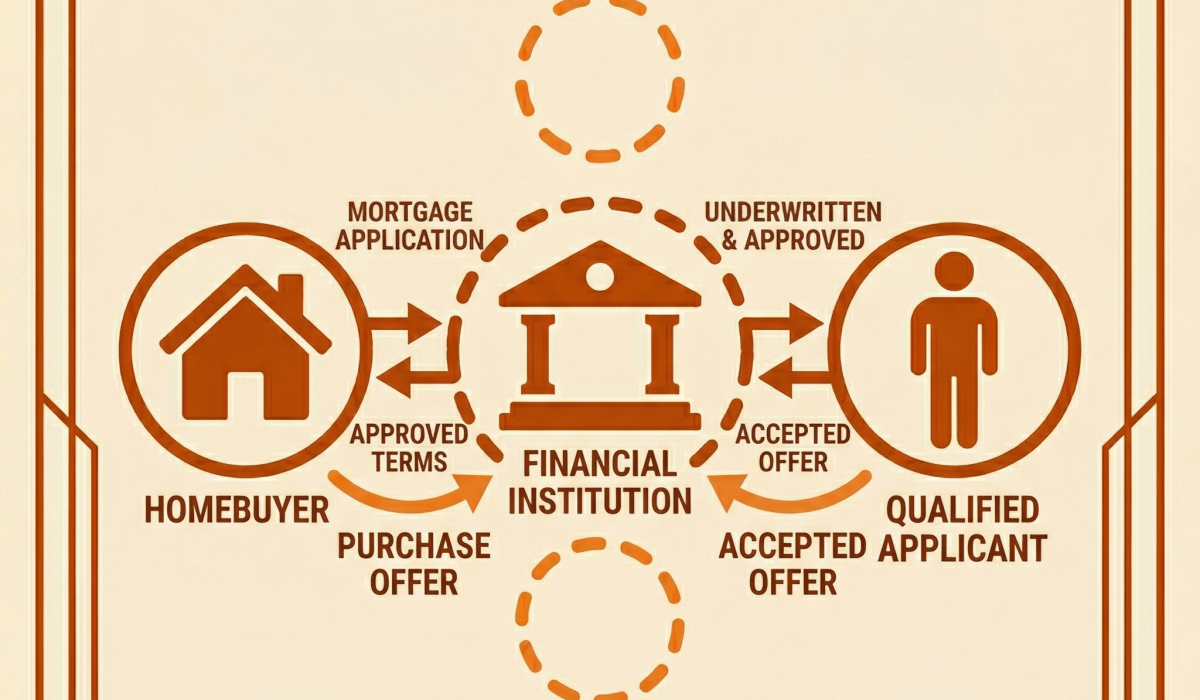
A mortgage is a loan used to purchase a home. You borrow money from a lender, buy the home, and repay the loan over time — typically 25 years in Canada — with interest. Your monthly payment covers four things:
- Principal — The portion paying down your actual loan balance
- Interest — The lender’s fee for lending you the money
- Property taxes — Often collected monthly and held in trust
- Home insurance — Required by all lenders
All federally regulated lenders in Canada apply the mortgage stress test — you must qualify at your contract rate + 2%, or 5.25%, whichever is higher. This ensures you can handle rate increases at renewal time.
Step 2: Know How Much Home You Can Afford in 2026
Before falling in love with listings, know your numbers. Canadian lenders use two key ratios:
- GDS (Gross Debt Service) — Housing costs should be no more than 39% of gross monthly income
- TDS (Total Debt Service) — All debts combined should be no more than 44% of gross monthly income
Upfront Costs You Must Budget For
Step 3: Know Your Mortgage Options in Canada
Conventional Mortgage
- 20%+ down payment required
- No CMHC mortgage default insurance needed
- Access to the best rates available
- Requires strong credit score (680+)
CMHC Insured Mortgage
- As low as 5% down payment
- Insurance premium added to mortgage balance
- Paradoxically gives access to lowest lender rates
- Minimum credit score ~600
First Home Savings Account (FHSA)
- Contribute up to $8,000/year (lifetime max $40,000)
- Contributions are fully tax-deductible
- Withdrawals for a first home purchase are completely tax-free
- Can be combined with the RRSP Home Buyers’ Plan ($35,000 limit)
You may also qualify for: the First-Time Home Buyers’ Tax Credit ($1,500 federal credit), the GST/HST New Housing Rebate on new builds, and provincial land transfer tax rebates (e.g., up to $4,000 in Ontario).
Step 4: Get Pre-Approved Before You Start House Hunting
Pre-qualification is a rough estimate. Pre-approval is a full lender review — and it’s the step that makes sellers take you seriously. It includes a hard credit check, income and asset verification, and gives you a specific loan amount and rate hold (typically 90–130 days free).
Documents You’ll Need for Pre-Approval
- Last 2 years of T4s and Notice of Assessments (NOAs)
- Last 30–90 days of pay stubs
- Last 3 months of bank statements (showing down payment source)
- Government-issued ID
- Employment letter confirming salary and tenure
- Gift letter (if receiving down payment help from family)
Step 5: The Full Mortgage Process — Week by Week
Week 1–2 Get Pre-Approved
Apply with a lender or broker, submit documents, receive pre-approval letter with rate hold.
Week 2–8 House Hunting
Work with a real estate agent to find homes within your budget. Make offers. Your rate hold protects you throughout.
Week 8–9 Offer Accepted
Once your offer is accepted, formally apply for the mortgage and satisfy conditions (inspection, financing).
Week 9–11 Inspection & Appraisal
Home inspection uncovers any issues. Lender orders an appraisal to confirm property value.
Week 11–13 Underwriting
Lender verifies your full application. Respond quickly to any document requests to avoid delays.
Closing Day 🔑 You’re a Homeowner!
Your lawyer finalizes the title transfer, mortgage funds are released, and you receive your keys.
First-Time Buyer Mistakes to Avoid in 2026
Don’t buy a car, furniture, or appliances before you close. New debt changes your TDS ratio and can kill your approval at the last minute.
Lenders want stable employment history. A job change mid-application — even for more money — can delay or derail your mortgage approval.
Your bank isn’t always the best option. Comparing at least 3 lenders — or using a mortgage broker — is one of the highest-ROI actions you can take as a first-time buyer.
Many buyers budget only for the down payment. Legal fees, land transfer taxes, and other closing costs can add $10,000–$25,000+ to your total upfront cost.
Keep 2–3 months of mortgage payments as a reserve after closing. Lenders check for this, and it protects you from unexpected expenses after moving in.
Frequently Asked Questions
How much do I need for a down payment in Canada in 2026?
Minimum 5% on homes up to $500,000; 10% on the portion between $500,000–$999,999; 20% on homes priced at $1 million or more. The FHSA and RRSP Home Buyers’ Plan can both help fund your down payment.
What credit score do I need to get a mortgage in Canada?
A minimum of 600 is generally required for CMHC-insured mortgages. A score of 680+ is preferred by major banks, and 720+ qualifies you for the most competitive rates available.
What is the mortgage stress test in Canada?
The stress test requires you to qualify at your contract rate + 2%, or 5.25%, whichever is higher. It applies to all federally regulated lenders and ensures you can afford your mortgage if rates rise at renewal.
What is the First Home Savings Account (FHSA)?
The FHSA lets first-time buyers in Canada contribute up to $8,000/year (lifetime max $40,000). Contributions are tax-deductible and withdrawals for a qualifying first home purchase are completely tax-free — making it one of the best savings tools available.
Should I use a mortgage broker or go directly to my bank?
A mortgage broker shops your application across dozens of lenders at no cost to you. They often secure rates and terms your bank won’t match if you walk in directly. Always worth comparing — especially for first-time buyers.
How long does the mortgage process take in Canada?
From pre-approval to closing typically takes 30–60 days. Having your documents ready and responding quickly to lender requests keeps things on schedule.
Your First Home in 2026 Is Closer Than You Think
Our licensed mortgage specialists help first-time buyers across Canada navigate the process from application to keys in hand — no pressure, no obligation.