

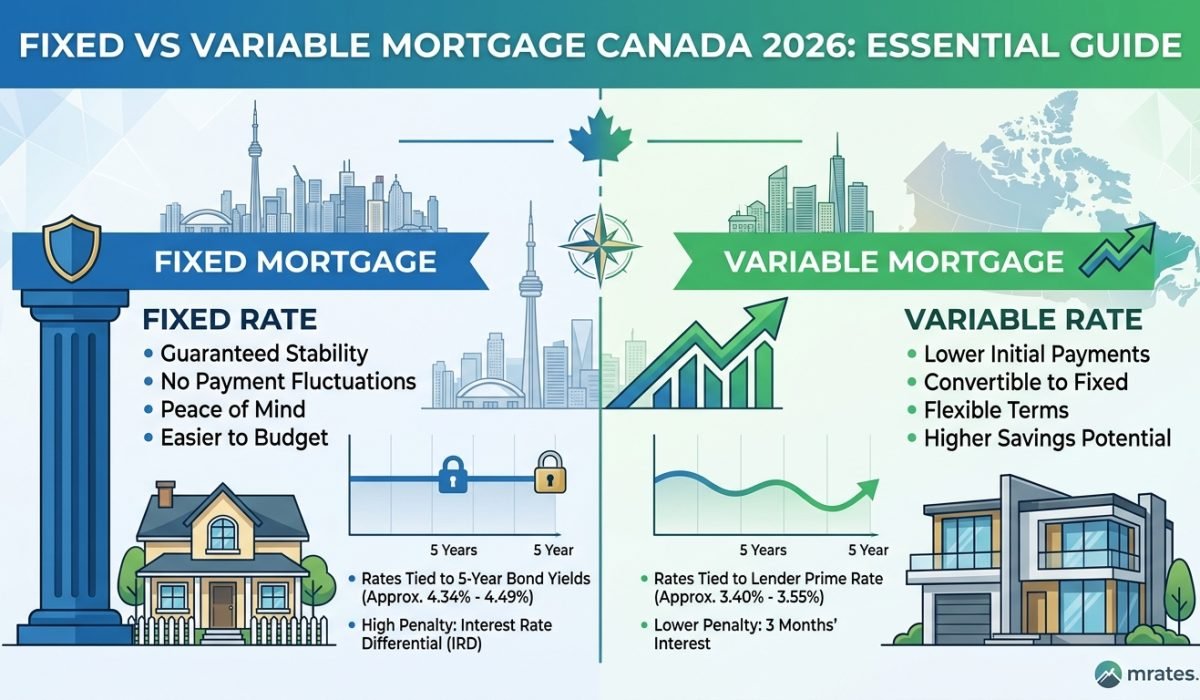
Signing a new mortgage or renewing an old one in 2026 brings you to one fork in the road. You can take a fixed rate that holds steady for the whole term, or a variable rate that moves with the Bank of Canada. The fixed vs variable mortgage question is closer this year than it has been since 2021, because variable rates are now priced below fixed rates for the first time in three years. This guide walks through where rates sit today, what the Bank of Canada is signalling, and the plain math behind each side, so you can pick what fits your budget and your tolerance for surprises.
Where rates actually sit in October 2026
The Bank of Canada has held its overnight rate at 2.25% since December 2025, and held again at its September 2026 meeting. That puts the prime rate most lenders use at about 4.45%. The next rate decision lands on October 28, 2026, alongside an updated Monetary Policy Report, so the backdrop could shift within weeks.
For best-in-market borrowers, five-year variable rates are sitting near 3.35%, while five-year fixed rates are closer to 3.7% to 4.0%. The gap is small, but the direction is new: variable is the cheaper starting point right now. That single change is why the fixed vs variable mortgage decision deserves a fresh look in 2026 rather than defaulting to whatever you chose last time.
What drives each rate
The two rates are powered by different engines, and knowing which is which tells you what to watch. A variable rate tracks your lender’s prime rate, which moves in lockstep with the Bank of Canada’s overnight rate. A fixed rate follows the five-year Government of Canada bond yield, which is set by bond markets rather than the central bank. That is why fixed rates have edged up in 2026 even while the Bank sits still: bond yields rose on inflation worries and global volatility, and lenders passed that through to fixed pricing. In a fixed vs variable mortgage comparison, the fixed side can move before the Bank does anything, while the variable side only changes on a rate decision.
The case for a fixed mortgage
A fixed rate buys certainty. Your payment is locked for the term, so a rate hike cannot touch you and budgeting is simple. In a year when the Bank of Canada has flagged rising upside risks to inflation and has said it is prepared to adjust policy, that protection has real value.
Fixed rates suit a borrower who is stretched close to the top of their budget, who plans to stay put for the full term, or who simply sleeps better knowing the number will not change. The trade-off is cost and flexibility. You usually pay a small premium over the opening variable rate, and if you break a fixed mortgage early the penalty is calculated on an interest rate differential, which can run to thousands of dollars.
The case for a variable mortgage
A variable rate starts lower in 2026 and rewards you immediately if the Bank of Canada cuts. Some forecasts still allow for a cut or two later in the year if the economy weakens, and every quarter-point cut flows straight to your rate. Variable mortgages also carry gentler break penalties, usually three months of interest, which matters if you might move or refinance before the term ends.
The risk runs the other way too. If inflation forces the Bank to raise rates, a variable rate climbs with it. On a fixed-payment variable mortgage, a higher rate means more of each payment goes to interest and less to principal, which can quietly stretch out your amortization. Variable suits a borrower with room in the budget to absorb a rise, a shorter expected holding period, or a belief that rates are more likely to fall than climb from here.
The math on a real example
Take a $500,000 mortgage on a 25-year amortization. At a 3.9% fixed rate, the monthly payment is roughly $2,600. At a 3.35% variable rate, it is about $2,460, a saving near $140 a month, or about $1,680 over the first year, as long as the Bank of Canada holds or cuts.
Now flip it. If prime rises by half a point during the term, that variable payment can climb past the fixed payment, and the early savings get eaten. The honest answer on fixed vs variable mortgage pricing is that neither option wins on paper alone. The right choice depends on how much a payment increase would hurt you and how confident you are about the rate path. Run your own numbers through our mortgage payment calculator before you commit.
Do not forget the stress test
Whichever side of the fixed vs variable mortgage choice you land on, a federally regulated lender still has to qualify you under the mortgage stress test. You must show you could afford payments at either your contract rate plus two percentage points, or 5.25%, whichever is higher. That rule has quietly steadied the 2026 renewal market, because borrowers were approved with a cushion already built in.
A hybrid worth knowing about
Some lenders offer a hybrid or combination mortgage that splits your balance, part fixed and part variable. It hedges the decision: you get some certainty and some upside if rates fall. The downside is added complexity and fewer lenders offering sharp pricing, so compare it against a straight fixed or variable before choosing it.
So which should you pick in 2026?
If your budget is tight and certainty matters more than saving a few dollars a month, a fixed mortgage is the safer call this year. If you have breathing room, a shorter horizon, or you expect the Bank of Canada to hold or cut, a variable mortgage gives you the lower starting rate and the cheaper exit. Many borrowers also shorten the term to three years rather than five, which keeps the fixed vs variable mortgage decision open again at the next renewal in a possibly lower-rate environment.
Rates and lender offers change week to week, so compare current numbers on the Bank of Canada policy rate page and across lenders through a tool like Ratehub before you sign. If you want the fixed vs variable mortgage decision run against your own income, down payment and timeline, talk to a licensed agent who can shop multiple lenders at once. Our team does exactly that, and if a renewal is on your horizon, read the 2026 Ontario renewal guide next.