

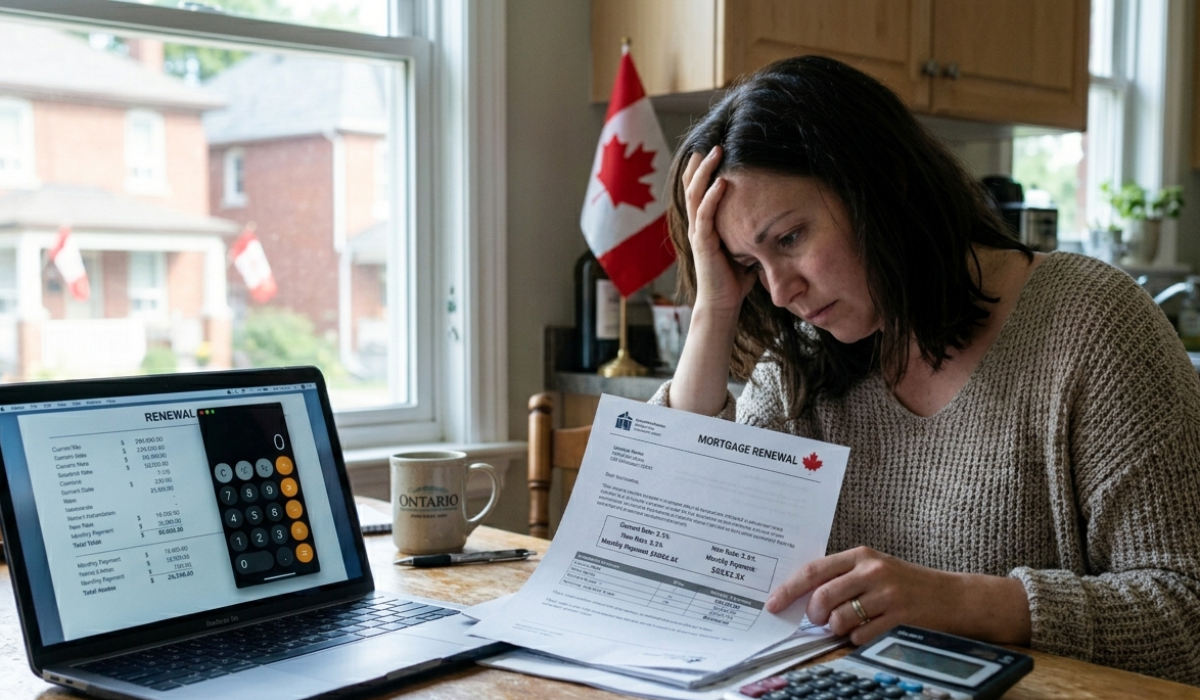
The Canada Mortgage and Housing Corporation estimates that approximately 1.2 million Canadian mortgages will come up for renewal in 2026. Most of these were originated during the pandemic rate era — when 5-year fixed rates were as low as 1.59%–2.09%. Renewing into today’s environment of 4.14%–4.24% means real, significant payment increases. This guide gives you the exact numbers, the best negotiation tactics, and every option available to manage your renewal in June 2026 and beyond.
The Renewal Shock in Real Numbers — June 2026
| Original Rate (2020–2021) | New Rate (June 2026) | Monthly Increase ($500K balance) | Annual Increase |
|---|---|---|---|
| 1.59% | 4.14% | +$737/mo | +$8,844/yr |
| 1.89% | 4.14% | +$662/mo | +$7,944/yr |
| 2.09% | 4.14% | +$611/mo | +$7,332/yr |
| 2.49% | 4.14% | +$510/mo | +$6,120/yr |
Calculations assume 25-year original amortization, balance after 5 years of payments. Monthly increase is on 20-year remaining amortization at renewal. Actual amounts vary.
The Single Biggest Mistake at Renewal: Accepting the First Offer
Canadian banks routinely send renewal letters 3–4 months before maturity with rates 0.30%–0.60% above their best negotiated rate. Why? Because roughly 70% of Canadians sign the renewal letter without shopping — and the banks know this. A single phone call or broker referral consistently produces materially better rates. Here is what the spread looks like in June 2026:
| Rate Source | 5-Year Fixed (June 2026) | 5-Year Interest Cost ($480K balance) |
|---|---|---|
| Best broker rate | 4.14% | ~$93,600 |
| Big bank negotiated | 4.44% | ~$100,300 |
| Big bank renewal letter (auto) | 4.74% | ~$107,100 |
The difference between accepting the renewal letter and using a broker: ~$13,500 over 5 years on a $480,000 balance. That’s a meaningful amount for any household absorbing a payment increase at renewal.
The OSFI Rule Change That Changes Everything at Renewal
Since November 2024, uninsured mortgage borrowers (20%+ down) no longer face the stress test when switching lenders at renewal. This is a game-changer. Previously, switching to a new lender required requalifying at your contract rate + 2% — locking many borrowers into their existing lender even if better rates existed elsewhere.
Now, if your mortgage is uninsured, you can switch to any lender offering the best rate at renewal with a straightforward transfer — no requalification under the stress test, no income reverification in most cases. Use this freedom.
Your Renewal Action Plan for June 2026
| Timeline | Action | Why It Matters |
|---|---|---|
| 120 days out | Contact a mortgage broker — get rate quotes from 30+ lenders | With rates drifting higher in June 2026, locking in a rate hold now protects you |
| 90 days out | Receive and review your bank’s renewal letter — do NOT sign | Signing early with your bank forfeits your negotiating leverage completely |
| 60–90 days out | Use broker’s best rate quote to negotiate with your current lender | Banks frequently match or beat broker rates when presented with competition |
| 30–45 days out | Decide: stay with bank at negotiated rate, or switch to best broker lender | Leave enough time for transfer documentation if switching lenders |
| Renewal day | Review term choice (3-year vs. 5-year) given June 2026 rate outlook | 3-year fixed at ~4.19% may be optimal if rates ease in 2027–2028 |
3-Year vs. 5-Year Fixed at Renewal in June 2026
With the BoC holding and rate hikes re-emerging as a risk, the term choice at renewal is more important than usual:
- 5-year fixed (~4.19–4.24%): Locks in certainty through 2031. If the Scotiabank rate hike scenario materializes, you’re protected. If rates fall sharply, you’re locked in — but the penalty to break early (IRD) must be factored in.
- 3-year fixed (~4.19–4.29%): Almost the same rate with 2 fewer years of lock-in. Renews in 2029 — when rates may be lower if the Iran-driven inflation is resolved. The flexibility premium is minimal at today’s spread between 3-year and 5-year.
- Variable (~3.60% at prime–0.85%): Currently cheaper than fixed, but with rate hike risk now explicit. Suitable for borrowers with high risk tolerance and short-term plans.
Don’t let your bank auto-renew you. Shop renewal rates from 30+ lenders — free — at mrates.ca. Updated June 10, 2026.
Frequently Asked Questions
How much will my mortgage payment increase at renewal in 2026?
It depends on your original rate and remaining balance. A $500,000 balance renewing from 1.89% to today’s best rate of 4.14% sees a monthly payment increase of approximately $662. Use the renewal calculator at mrates.ca for your exact numbers.
Do I need to requalify when switching lenders at renewal?
Not for uninsured mortgages since November 2024. OSFI removed the stress test requirement for uninsured borrowers switching lenders at renewal — you can now switch to the best available rate without requalifying under the 2% buffer.
What is the best mortgage renewal rate in Canada right now?
As of June 10, 2026, the best broker-sourced 5-year fixed renewal rate for uninsured mortgages is approximately 4.14%–4.19%. Rates are drifting higher due to rising bond yields. Get a current quote at mrates.ca.