
Buying your first place is expensive, but a first-time home buyer in Ontario has more help available in 2026 than at almost any point in the past decade. Between federal savings accounts, tax credits, land transfer rebates, a new GST break on new homes, and looser mortgage rules, the programs can add up to tens of thousands of dollars. This guide walks through each one, who qualifies, and how they stack together so you can plan your purchase with the full picture in front of you.
The two accounts that build your down payment
Two registered accounts let a first-time home buyer save for a down payment with a tax advantage, and you can use both.
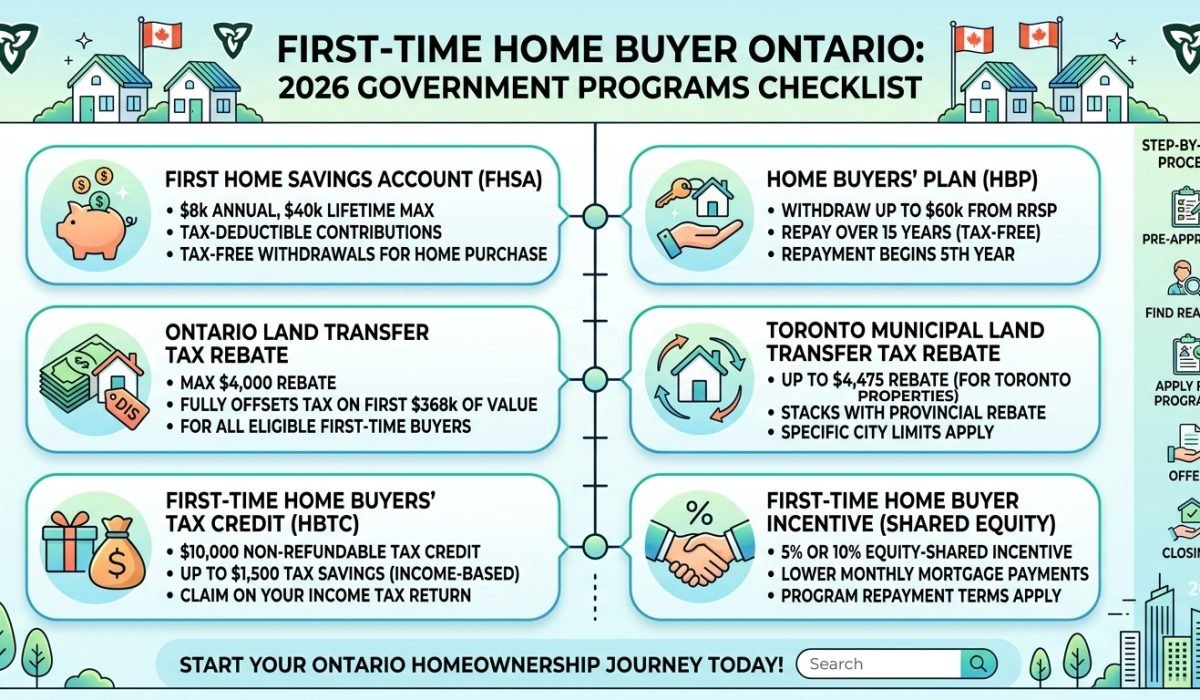
The First Home Savings Account (FHSA) lets you contribute up to $8,000 a year, to a lifetime maximum of $40,000. Contributions are tax-deductible like an RRSP, and withdrawals for a qualifying first home are tax-free like a TFSA. For most first-time buyers it is the single best place to hold down-payment savings.
The RRSP Home Buyers’ Plan (HBP) lets you withdraw up to $60,000 from your RRSP toward a first home, repaid over 15 years. A couple buying together can each withdraw $60,000, for $120,000 combined. Many first-time home buyers use the FHSA and the HBP together, since both can fund the same purchase.
Tax credits and land transfer rebates
Several rebates put money back after you buy. The federal First-Time Home Buyers’ Tax Credit gives a $10,000 non-refundable credit, worth about $1,500 off your tax bill.
On closing, Ontario charges land transfer tax, and a first-time home buyer qualifies for a provincial rebate of up to $4,000. If you buy in the City of Toronto, there is a second, municipal land transfer tax with its own first-time buyer rebate of up to $4,475. A first-time buyer in Toronto can therefore claim up to $8,475 across both rebates, which can wipe out the land transfer tax entirely on a modestly priced home.
The new GST rebate on new homes
A federal First-Time Home Buyers’ GST Rebate, introduced in 2025, removes the 5% GST on a newly built or substantially renovated home for eligible first-time buyers. The full rebate applies to homes priced up to $1 million and phases out between $1 million and $1.5 million. On a $1 million new build that is up to $50,000 back, which is one of the largest single incentives available to a first-time home buyer today. It applies only to new or substantially renovated homes, not resale, so confirm current eligibility details before you count on it.
The mortgage rules changed in your favour
Two changes that took effect at the end of 2024 still help first-time buyers in 2026. The price cap for an insured mortgage, the kind that allows a down payment under 20%, rose to $1.5 million, which brings many Greater Toronto Area homes within reach of a smaller down payment. And 30-year amortizations are now allowed on insured mortgages for first-time buyers and for anyone buying a newly built home, which lowers the monthly payment compared with the old 25-year limit.
Minimum down payment rules still apply on a sliding scale: 5% on the first $500,000 of the price, and 10% on the portion between $500,000 and $1.5 million. On a $700,000 home, that works out to a minimum down payment of $45,000. You can see what different down payments do to your payment with our mortgage payment calculator.
How the programs stack on a real purchase
Picture a first-time home buyer couple purchasing a $700,000 resale home in Brampton. They each hold an FHSA and draw on their RRSPs through the Home Buyers’ Plan to assemble the down payment. At closing, the Ontario land transfer tax rebate trims up to $4,000 off their tax, and they each claim a share of the First-Time Home Buyers’ Tax Credit. The GST rebate does not apply here because the home is a resale, but every other program does. Stacking the accounts and rebates is what turns a daunting purchase into a workable one.
Getting mortgage-ready as a first-time buyer
Before you shop for a home, get a mortgage pre-approval so you know your real budget and can lock a rate while you look. A lender still has to qualify you under the stress test, meaning you must show you could handle payments at your contract rate plus two percentage points, or 5.25%, whichever is higher. It is also the moment to choose your rate type, and our fixed vs variable guide walks through that decision for 2026.
The programs above are generous, but the paperwork and timing matter, and a missed rebate deadline is money left on the table. Read the official rules for the FHSA and the Ontario land transfer tax refund, then talk to a licensed agent who works with first-time buyers to line up your pre-approval and make sure you claim everything you are owed.